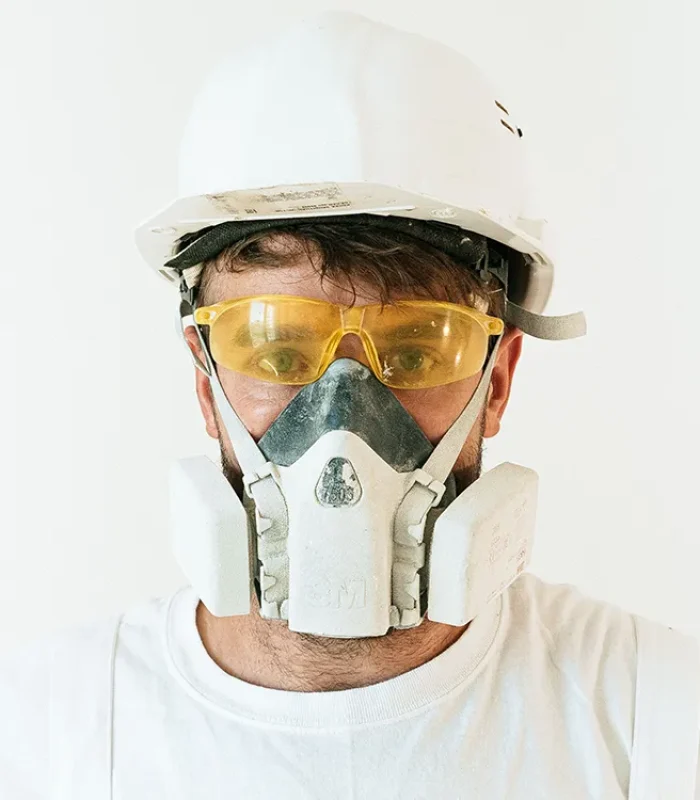
Handing a worker a P2 mask and assuming it’s doing its job is one of the easiest mistakes to make, and one of the easiest to get caught out on.
Mask fit testing isn’t a once-off when someone starts a job. It’s required at several points throughout a worker’s time wearing a respirator, and it’s a legal requirement under the Work Health and Safety Regulation regardless of how short the job might be.
This guide explains exactly when fit testing applies, why it matters, and what NSW law requires you to do as an employer.
Why does respiratory fit testing matter?
When exactly is fit testing required?
Which respirators need fit testing?
How does fit testing actually work?
What records do you need to keep?
Fit testing versus fit checking
Common fit testing questions
What happens if a worker fails a fit test?
Do casual or short-term workers still need fit testing?
How long does a fit testing session usually take?
Lock in your team’s fit testing today
A summary of when fit testing is required in NSW
|
Why does respiratory fit testing matter?
Fit testing exists to catch a problem you can’t see or feel.
Evidence compiled by the NSW Agency for Clinical Innovation shows that around 20% of workers completely fail their initial respirator fit test. Relying purely on a visual check simply doesn’t work; invisible facial leaks are incredibly common.
If there isn’t a good face seal, the wearer may not get the level of protection the respirator is meant to provide.
Respirators come in different shapes and sizes, and one size doesn’t fit everyone. A mask that seals well on one worker’s face can leak badly on another’s, even if both are wearing the exact same model.
When exactly is fit testing required?
There’s no single date you can circle on a calendar and call it done. Fit testing is triggered by specific events, not just by a calendar date.
According to SafeWork NSW, all fit testing must be carried out by a competent in-house person, manufacturer, supplier or consultant in four situations.
| Trigger | Why it applies |
| Before first use | A worker must never wear a close-fitting respirator for work without being fit tested first. |
| New make or model issued | Different respirators seal differently, even within the same general type. |
| Change in facial features | Weight loss, weight gain, dental work or other facial changes can affect the seal. |
| Annually | Even without any other trigger, a fit test must be repeated at least once a year. |
Which respirators need fit testing?
It’s easy to assume every mask on site falls under the same rule, and that assumption can cost you. Not every type of respiratory protective equipment needs fit testing, and knowing the difference matters before you book a session for your team.
Fit testing applies specifically to close-fitting respirators, where the seal between the mask and the worker’s face is what makes the protection work.
This is required for:
- Half facepiece respirators, including disposable types such as P2 and N95
- Full facepiece respirators, whether reusable or fitted with filters
Fit testing is not required for positive-pressure, loose-fitting head tops or hoods connected to a powered air-purifying respirator or a compressed-air airline hose, since these don’t rely on a tight seal against the face to work.
Other fitting requirements
One condition applies regardless of respirator type: workers must be clean-shaven above the cheeks, neck and jaw where the respirator makes contact.
Facial hair in that area prevents a proper seal, and SafeWork NSW is explicit that workers who aren’t clean-shaven must not be provided with close-fitting RPE.
How does fit testing actually work?
Fit testing measures whether a specific respirator actually seals against a specific worker’s face. SafeWork NSW recognises two methods that meet AS/NZS 1715:2009, the Australian Standard for selecting, using and maintaining respiratory protective equipment.
The two accepted methods are:
- Qualitative fit testing
A pass-or-fail test in which the worker reports whether they can taste or smell a test agent. This method can only be used for half-face respirators.
- Quantitative fit testing
Specialised equipment measures exactly how much air leaks into the respirator. This method works for both half and full-face respirators.
Both methods require the worker to perform a series of movements, such as talking, nodding and turning their head, to simulate normal work conditions while the seal is being assessed.
| “You’d be surprised how many teams are accidentally in breach. That’s why proper, regular testing is a must.” Kate O’Connor, National Program Manager, Munro Respiratory Services |
What records do you need to keep?
If you can’t produce proof, it’s the same as if the test never happened. A fit test that isn’t documented makes it hard to prove your compliance if it’s ever questioned.
SafeWork NSW requires a written record to be kept for each worker who has been fit tested, and that record needs to be specific enough to mean something later.
Each record must include:
- The type of test performed, qualitative or quantitative
- The make, model, style and size of the respirator tested
- The date of the test and the result
Keeping these records isn’t just a formality. If a worker changes role, moves to a different respirator model, or comes up for their annual retest, having the original record on file makes it far easier to track what’s due and when.
Fit testing versus fit checking
These two terms get used interchangeably on-site all the time, and that mix-up is exactly where gaps in protection creep in. Fit testing and fit checking sound similar, but do completely different jobs.
A fit test is a formal, once-a-year minimum assessment. A fit check is something a worker performs themselves every time they put on the respirator.
According to SafeWork NSW, a fit check should be carried out every time a worker puts on a close-fitting respirator that has already been fit tested, to confirm it’s been positioned correctly that day.
A fit check does not replace the need for a fit test. It’s a quick daily habit, not a substitute for the formal annual process.
Common fit testing questions
What happens if a worker fails a fit test?
If a worker fails a fit test, they must not use that respirator for hazardous work until a suitable alternative is identified and successfully tested.
This may involve trialling different sizes, models or respirator types until an adequate seal is achieved. Select another suitable respirator and repeat the test.
Do casual or short-term workers still need fit testing?
Yes. The length of employment or duration of the task does not remove the requirement. If the worker is required to wear close-fitting respiratory protective equipment, they must be fit tested before first use, even for short-duration work or labour hire placements.
How long does a fit testing session usually take?
Most individual fit tests conducted by Munro Respiratory Services take around 10 to 15 minutes, depending on the type of respirator being tested and whether multiple mask options need to be trialled.
Larger team bookings may require additional time for setup, education and recordkeeping.
Can one fit test cover multiple respirator brands?
No. Fit testing is specific to the exact make, model, style and size of the respirator worn. If a worker changes to a different brand or model, even if it looks similar, a new fit test is required.
Lock in your team’s fit testing today
A respirator nobody’s checked the fit on isn’t protection, it’s a false sense of one. If your workers wear a P2, N95, half-face or full-face respirator on the job, fit testing is something you need to have sorted, not something to get to eventually.
Munro Respiratory Services delivers on-site respiratory fit testing across NSW, with certificates issued promptly and automated reminders so your team’s annual retest never sneaks up on you.
Tell us how many people need testing, and we’ll arrange a session that fits around your site.