Airborne particle exposure at work is one of those risks that’s easy to underestimate because you usually can’t see the damage happening. Over time, breathing in that repeated low-level exposure leads to serious, irreversible lung damage.
For instance, around 600,000 Australian workers are exposed to silica dust each year, making it one of the most common airborne workplace hazards in the country.
For employers, this leaves you with two distinct jobs: you need to reduce on-site exposure wherever possible, and you need documentation to prove your business is fully compliant and that your workers are actually protected.
This guide breaks down the practical risks of workplace airborne particles, what they do to the human body, and how NSW employers can stay on the right side of the law.
What counts as airborne particle exposure at work?
What are the health risks of airborne contaminants?
Which industries face the highest exposure risks?
What are employer responsibilities under NSW law?
How can workplaces reduce airborne exposure?
Common airborne exposure questions
Protect your workers before exposure becomes a problem
A summary of airborne particle exposure risks and employer responsibilities
|
What counts as airborne particle exposure at work?
Airborne particle exposure at work simply means tiny solid or liquid particles suspended in the air that your team breathes in. Some are visible, but the most dangerous ones are microscopic.
The smaller the particle, the deeper it travels into the lungs, where it gets permanently trapped.
Workplace airborne contaminants generally fall into a few key categories: fumes, mists, gases, vapours, dust, and other potentially harmful substances. Different types of these contaminants include:
- Silica dust:Generated from cutting, grinding, or drilling concrete, brick, and stone.
- Welding fumes:Created during metal fabrication and mechanical work.
- Wood dust:Thrown into the air from cutting and sanding timber.
- Asbestos fibres:Disturbed during demolition, strip-outs, or renovations.
- Chemical mists:Released during the spraying of paints, coatings, or industrial cleaning products.
Not every airborne hazard behaves the same way. Some heavy dust settles quickly, while fine dust particles remain suspended in the breathing zone for hours.
Identifying exactly what your team is breathing is always the starting point.
What are the health risks of airborne contaminants?
Breathing in these contaminants can cause immediate issues, but the real danger is the slow, hidden damage that builds up over years of repetitive exposure.
Long-term exposure to hazardous dust like crystalline silica leads to severe conditions like silicosis, chronic obstructive pulmonary disease (COPD), and lung cancer.
Short-term effects
These are the early warning signs that your site’s controls aren’t working. They are easy to dismiss as a minor irritation, but they point to a much bigger exposure issue:
- Persistent coughing
- Throat and eye irritation
- Sudden shortness of breath
- Headaches and chest tightness
Long-term effects
This is where irreversible respiratory damage occurs.Occupational lung diseases remain a common cause of preventable workplace illness in the country.Long-term exposure contributes directly to:
- Silicosis
- Occupational asthma
- Chronic bronchitis
- Lung cancer
For workers, these aren’t just medical diagnoses. They are life-altering conditions that gradually steal your ability to breathe. They force people out of their jobs early, causing lasting physical and emotional strain for both the workers and their families.
The reality of prevention
Occupational lung diseases are devastating, but they are entirely preventable. Protecting your team through robust training and respirator fit-testing is far simpler than dealing with the medical and regulatory consequences down the track.
Which industries face the highest exposure risks?
Airborne exposure isn’t just a problem for heavy mining or specialist demolition crews. Any task that cuts, burns, sprays, grinds, or physically disturbs raw materials puts workers at risk.
| Industry | Common airborne hazards |
| Construction and demolition | Silica dust, asbestos fibres |
| Manufacturing and foundries | Metal fumes, chemical vapours |
| Joinery and carpentry | Fine wood dust |
| Mining, quarrying and drilling | Mineral dusts, respirable quartz |
| Painting and coating | Solvent mists, chemical aerosols |
The specific industry matters because a control that works in a joinery shop won’t cut it on a civil demolition site. Knowing your specific industry risk dictates your legal compliance pathway.
What are employer responsibilities under NSW law?
As an employer in NSW, you have a legal duty to manage airborne contaminants so far as reasonably practicable.
SafeWork NSW expects a proactive risk management process. You can’t just hand out masks and consider it sorted; you have to run through a clear framework:
Identify the hazard:Pinpoint exactly what dusts or fumes are being generated across different jobs.
Assess the risk:Look at how long workers are exposed, the dust concentration, and how ventilation handles it.
Control the exposure:Implement practical safety measures like wet cutting methods, local exhaust ventilation, or extraction systems.
Monitor and review:Put verification steps in place. This includes regular air monitoring, health monitoring records, safety training and mandatory annual respiratory fit testing.
How can workplaces reduce airborne exposure?
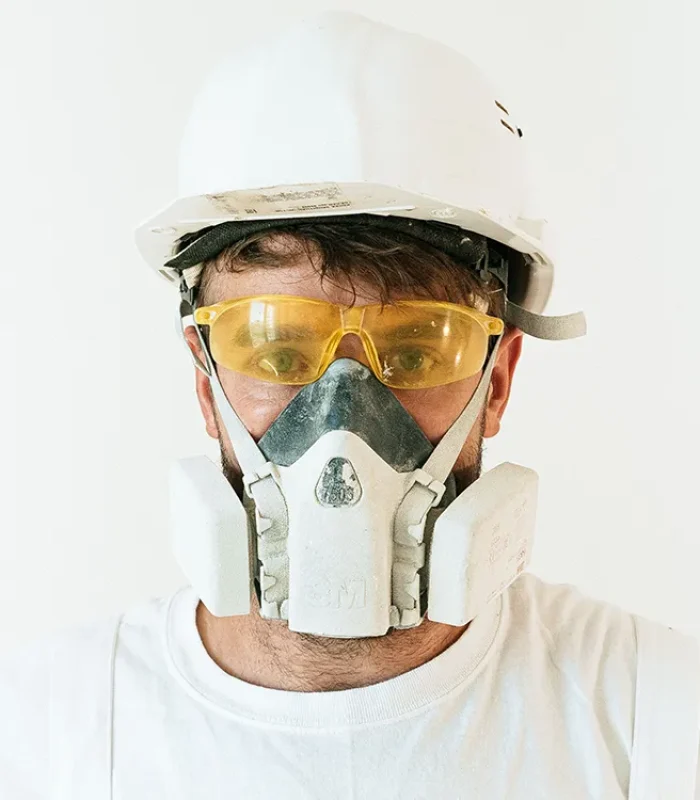
The safest way to manage airborne hazards is to stop them from entering the air in the first place. Tight-fitting respirators are critical, but they are your last line of defence, not your first.
A simple breakdown looks like this:
- Eliminate the airborne hazard where possible
- Substitute with safer materials
- Isolate the source
- Engineer better ventilation
- Use administrative controls like safe work procedures
- Provide PPE as the last line of defence
Here is the catch with PPE: a respirator only works if it actually seals to the face. If a worker hasn’t been properly fit-tested, contaminated air simply bypasses the filter through small gaps in the seal, leaving them completely exposed.
| “A mask that doesn’t fit properly is nothing more than a false sense of security. If toxic, microscopic dust can find a gap in the seal, it will bypass the filter entirely. Real protection relies on a verified, airtight seal and a team that knows exactly how to wear their gear.” Kate O’Connor, National Program Manager, Munro Respiratory Services |
With Munro Respiratory Services, we bring our mobile fit-testing equipment directly to your NSW workplace, testing your team efficiently (roughly 15 minutes per person) so you don’t lose a day of productivity.
Common airborne exposure questions
What else must be considered before running a fit test?
Workers must be completely clean-shaven where the mask touches the skin; even a day’s stubble causes seal failure.
If we already use dust extraction and wet cutting, is fit testing required?
Yes. On-tool water suppression and extraction hoods significantly reduce dust levels but rarely eliminate microscopic particles entirely. If your risk assessment shows masks are still needed as a final safety backup, NSW law requires a passed fit test to prove they actually seal.
How long do we legally have to keep worker health and training records?
Under the NSW WHS Regulation, you must securely archive all employee air-monitoring data, health records, and silica training logs for at least 30 years. Because occupational lung diseases take decades to develop, these records must remain retrievable even if a worker leaves your company.
What is the strict Workplace Exposure Limit change?
The Workplace Exposure Standards (WES) are being replaced by stricter, legally enforceable Workplace Exposure Limits (WEL).
Protect your workers before exposure becomes a problem
Managing airborne hazards doesn’t have to be complicated or disrupt your workday. Don’t wait for a SafeWork NSW inspector to find gaps in your respiratory safety program or your paperwork.
At Munro Respiratory Services, we bring both mandatory silica awareness training and accredited mask fit testing directly to your job site.
We handle the heavy lifting, delivering practical education, verifying mask seals, and issuing the digital compliance records you need to keep your business fully covered.